
There is a moment, right after the appointment, when something shifts internally. It’s not the new title or the new office. It’s a click: the person assumes that ultimate responsibility is now theirs.
That moment marks the beginning of a fascinating journey. Witnessing how a CEO emerges, how they unfold, how they begin to shape realities, expectations, and cultures — is witnessing one of the most complex transformations in the corporate world.
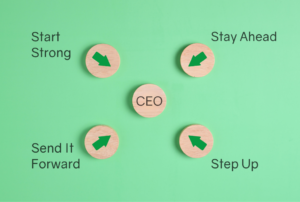
McKinsey documented it in A CEO for All Seasons: Mastering the Cycles of Leadership (Dewar, Keller, Malhotra and Strovink, 2025), identifying four phases every CEO goes through: Starting Strong, Staying Ahead, Stepping Up, and Sending It Forward.
These four seasons resonate with me because I have seen them in practice. Accompanying a CEO is not just observing strategic decisions. It is witnessing a person evolving under a pressure that is not seen in other roles.
Starting Strong: what doesn’t show up in the 100-Day Plan
When someone becomes CEO, everyone talks about 100-day plans, quick wins, clear messages to the organization.
But what happens internally is equally important. The new CEO is processing the real weight of responsibility. Learning to read the organization from a position they have never held before. Discovering what information arrives filtered and what they need to seek out themselves.
It’s not just about executing a plan. It’s the transition from thinking as a functional leader to thinking as the person ultimately accountable for everything. That expansion doesn’t happen overnight, even when external expectations assume it does.
The CEOs who navigate this phase well don’t arrive with all the answers. They arrive willing to listen, and are honest with themselves about the learning curve ahead — even when everyone expects immediate certainty.
Staying Ahead: the risk of losing touch with the truth
After the initial impact comes a different phase: sustaining performance, avoiding complacency, continuing to generate value year after year.
Here a silent risk emerges: progressive isolation. As the organization adapts to their leadership, the information they receive can become increasingly filtered, curated, and less honest.
Staying Ahead requires actively maintaining direct information channels, without intermediaries who soften the uncomfortable. It also requires the discipline to constantly review which decisions are still relevant and which are sustained only by inertia.
CEOs who maintain momentum share one trait: they remain curious. They don’t assume they have fully understood the business, the market, or their team. They keep asking the questions they asked in their first days, even years into the role.
Stepping Up: when what got you here is no longer enough
There are moments in a CEO’s journey when the context changes dramatically: a crisis, a digital transformation, a significant acquisition, a regulatory shift that redefines the rules of the game.
In those moments, the leadership that worked until then may not be sufficient. Stepping up means evolving your own leadership style to respond to something that requires a different version of you.
This is profoundly challenging because it means recognizing that the strengths that brought you here may not be the ones needed for what comes next. It requires humility, openness to developing new capabilities, and sometimes surrounding yourself with people whose perspectives complement your own limitations.
CEOs who achieve this evolution don’t do it alone. They seek support — whether through executive coaching, trusted advisors, or spaces where they can process the pressure without having to appear infallible.
Sending It Forward: the phase that defines your legacy
The final phase — and perhaps the least openly discussed — is the exit. How a CEO prepares to leave the role largely determines how their entire tenure will be remembered.
This phase requires something counterintuitive: thinking about the organization’s future beyond your own permanence. Investing in successors, ensuring critical knowledge doesn’t depend on a single person, and gradually releasing control so the transition is smooth.
For many leaders, this also involves a significant personal process: the professional identity they built over years is tied to the role they are about to leave. Navigating that transition with clarity — neither holding on too long nor disconnecting prematurely — is in itself an act of mature leadership.
The weight of the role
The ideal CEO in the corporate imagination projects constant confidence, clear vision at all times, zero doubt.
Holding that role is a source of pride, great responsibility, and many rewards — but also many sacrifices. It imposes isolation, unsustainable pressure, and decisions made from the need to maintain an image rather than from genuine clarity.
Humanizing the role doesn’t mean reducing its demands. It means recognizing that behind every strategic decision is a person navigating transitions as complex as the external challenges the organization faces.
A System, not just one Person
Accompanying a CEO’s evolution is not working with an isolated individual. It is working with a complete system.
How they navigate Starting Strong impacts how their executive team takes shape from the beginning. How they handle Staying Ahead determines whether the organization maintains agility or falls into complacency. Stepping Up redefines not only the CEO but the entire culture that must accompany that evolution. And Sending It Forward determines whether the organization is ready to sustain its trajectory beyond a single leader.
This is why accompanying a CEO in their evolution has an impact far beyond that individual: stronger teams, more resilient organizations, and communities that benefit from well-led institutions over the long term.
At Talent Advisor we accompany CEOs and senior executives through the different seasons of their leadership, creating spaces where the complexity of the role can be processed honestly, and where each transition becomes an opportunity for conscious evolution.
If your organization is going through a significant leadership transition, let’s talk.