
There’s one question that the world’s most inspiring leaders ask themselves before anyone else. It’s not what do we do? Nor how do we do it? It’s a deeper, more uncomfortable, and surprisingly harder question to answer: Why do we do it?
Simon Sinek has spent more than a decade studying what distinguishes leaders who inspire from those who simply lead. His conclusion is deceptively simple: leaders who inspire think, act, and communicate from the inside out. They start with the why.
The Golden Circle: A Framework for Understanding Conscious Leadership
Sinek proposes a model he calls the Golden Circle, composed of three concentric levels: Why, How and What.
Every organization and every leader knows what they are doing. Many know how they do it. But very few are clear about why they do it, and we are not talking about generating profits. That is an outcome, not a purpose.
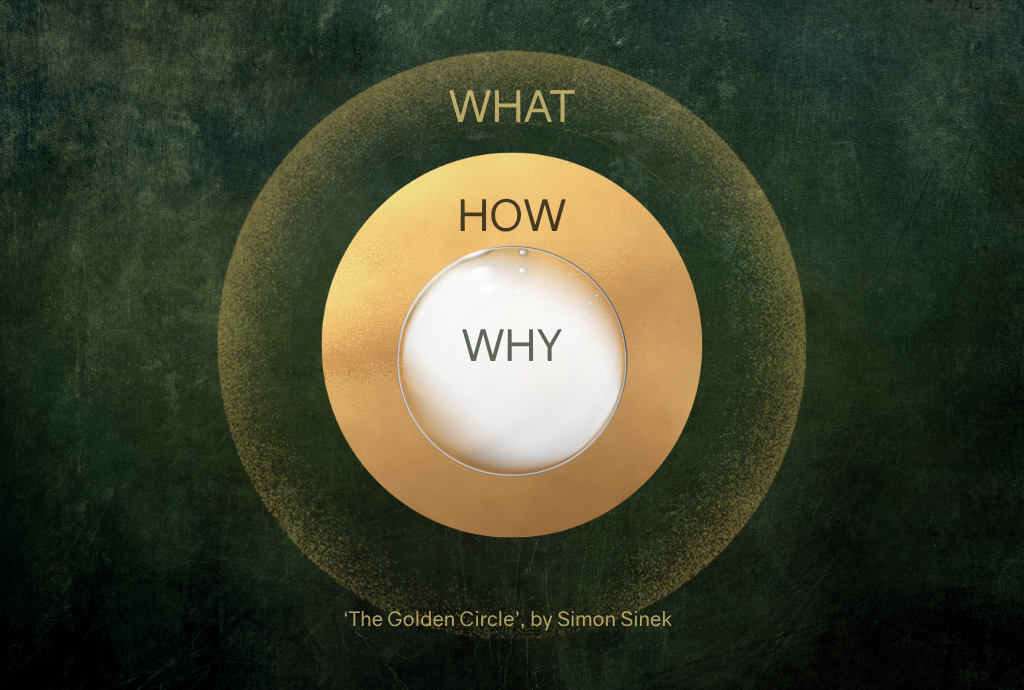
The “why” answers more essential questions: What is your purpose? What cause do you defend? What do you deeply believe in?
Most leaders communicate from the outside in. They start by explaining what they do, then how they do it, and rarely get to the why. And while that information may be perfectly rational and well-structured, it doesn’t inspire.
Leaders who inspire do the opposite: they start with the why, and let the what and how be the evidence of that purpose.
Why Self-Awareness Matters Before Leading Others
This is where Sinek’s principle has a direct implication for leadership development: you can’t inspire others from a place you haven’t explored yourself.
If a leader is not clear about his own purpose, if he does not know why he does what he does beyond results, he will not be able to generate in his team something more than fulfillment. And compliance, as Sinek rightly points out, is not the same as loyalty.
The difference between the Wright brothers and Samuel Pierpont Langley was not one of resources or talent. Langley had $50,000 from the War Department, connections to the best minds of the day, and coverage from the New York Times. The Wrights had a bicycle and a belief: that if they achieved powered flight, they would change the course of the world.
When the Wrights managed to fly in December 1903, Langley resigned. Not because he didn’t have capacity, but because his motivation was the result: fame, wealth; and since we did not arrive first, there was no longer any reason to continue. Those who worked with the Wrights, on the other hand, did so with conviction. Because they believed in the same thing as them.
Leadership that is born of purpose does not depend on the result to sustain itself.
Shared purpose as the basis of the partnership
When a leader is clear about their why, something important happens: they attract people who believe the same thing. And these people don’t just work for a paycheck — they work because they feel like they’re part of something worthwhile.
Sinek puts it clearly: the goal is not to hire people who need a job. It’s finding people who believe what you believe. Because those who share the purpose work with a level of commitment that no economic incentive can replicate.
This is exactly what happened in the summer of 1963 in Washington. Martin Luther King did not send invitations or publish invitations. 250,000 people did not come for him. They came by themselves, because what King believed resonated with what they believed about America.
King did not give the “I Have a Plan” speech. He gave the talk “I Have a Dream.”
And that distinction explains everything.
In the context of organizational leadership, this translates into a fundamental question that every leader should ask themselves before attempting to build high-performing teams:
Do the people I work with know why I do what I do? Do I myself know it clearly enough to communicate it?
The neuroscience behind why
What makes Sinek’s model especially powerful is that it is not just a theory of leadership. It’s backed up by the way the human brain works.
The neocortex, the newest part of the brain, processes rational information: data, facts, features, benefits. It is the part that understands the what and the how. It can process large volumes of complex information.
But decisions are not made there.
Decisions, loyalty, trust, commitment, all of that happens in the limbic system, the part of the brain responsible for emotions and behaviors. And this part has no language capacity.
That’s why when something “doesn’t feel right” even though all the data says it does, we’re not being irrational. We are being human. The part of the brain that makes decisions cannot explain in words what it feels, it can only act from it.
When a leader communicates from the why, he speaks directly to that part of the brain. It does not convince, it connects. And connection generates a kind of commitment that rational persuasion cannot produce.
What this means for leadership development
Sinek’s principle reminds us of something we constantly see in our work: the most effective leaders are not necessarily the most prepared or the best informed. They are the ones who have the greatest clarity about who they are and why they do what they do.
That clarity, part of what in our model we call Awareness, is the starting point of everything else.
The why is not an exercise in personal branding or a motivational slogan. It is the basis from which to lead with coherence, build teams with purpose and generate an impact that transcends quarterly results.
All conscious leadership begins with the same question: Why?
At Talent Advisor we help leaders and organizations to develop the self-knowledge, alliances and strategic knowledge that make real impact leadership possible. If you want to explore how the principle of why can transform your leadership or that of your team, let’s talk.